
NMN: The Cellular Spark Lighting the Longevity Conversation
If aging is a slow burn, NMN (nicotinamide mononucleotide) is being hailed as the fresh wick with potential to rekindle the flame. It’s a precursor to NAD+, a coenzyme vital in energy metabolism, DNA repair, circadian rhythm regulation, and cellular stress responses. As NAD+ naturally declines with age, NMN has emerged as a leading candidate for restoring it ([1], [2]).
Animal studies built the initial hype. In older mice, NMN supplementation restored muscle blood flow, increased capillary density, and returned exercise endurance to youthful levels. One landmark Harvard Medical School study found aged mice nearly doubled their running distance after NMN treatment, along with improvements in mitochondrial function and DNA repair ([3], [4]).
Human evidence, while newer, is growing. A single-dose safety trial of NMN up to 500 mg in healthy men reported no adverse effects ([5]). In a randomized placebo-controlled trial, prediabetic women taking 250 mg/day improved muscular insulin sensitivity and raised NAD+ in blood cells ([6]). A 60-day dose-ranging trial in healthy middle-aged adults (300 mg, 600 mg, 900 mg/day) showed dose-dependent NAD+ increases, longer walking distances, and higher self-reported health scores ([7]). Amateur runners supplementing 600–1 200 mg/day for six weeks saw significant gains in aerobic capacity ([8]). A recent 2025 study even suggested liposomal NMN raised NAD+ more efficiently than standard NMN in healthy men over four weeks ([9]).
Experiential reporting adds color. In The Daily Beast, a journalist skeptical at first described faster muscle recovery, higher daily energy, clearer cognition, better skin tone, and eczema relief after returning to NMN at 900 mg/day for 90 days ([10]). While anecdotal, such accounts drive much of NMN’s cultural momentum.
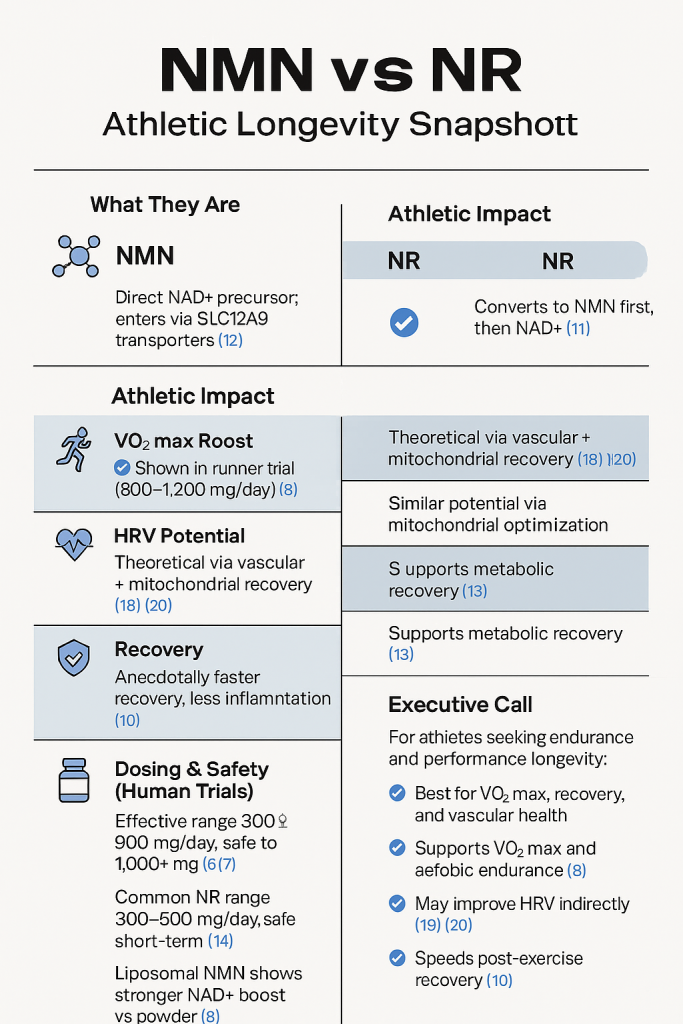
NMN vs NR: Two Roads to NAD+
NMN and NR (nicotinamide riboside) are both NAD+ precursors but differ in structure and how they enter cells. NR is a smaller molecule that must first convert into NMN via NR kinases before becoming NAD+, while NMN may enter cells directly using transporters like Slc12a8 ([11], [12]).
Some research suggests NMN’s effects are more pronounced in cardiovascular tissue and muscle, while NR shows stronger mitochondrial benefits in liver, brown fat, and skeletal muscle ([13]). Others note NR’s smaller size may give it higher bioavailability in certain contexts ([14]), though this doesn’t necessarily make it more effective across all tissues. In practical terms, both raise NAD+, but NMN has the advantage of skipping one metabolic step, which may allow for faster or more targeted cellular impact ([15]).
Quick Comparison: NMN vs NR for Athletes
| Feature / Benefit | NMN | NR |
|---|---|---|
| Primary Pathway | Direct precursor to NAD+, enters via Slc12a8 transporters ([12]) | Converts to NMN first, then to NAD+ ([11]) |
| Tissue Impact | Stronger evidence for cardiovascular tissue and muscle endurance ([3], [13]) | Stronger in mitochondrial activity in liver, brown fat, muscle ([13]) |
| VO₂ Max Potential | Positive effect shown in runners at 600–1 200 mg/day ([8]) | Limited direct VO₂ max data; benefits likely indirect |
| HRV Potential | Theoretical via improved endothelial and mitochondrial health ([19], [20]) | Theoretical via mitochondrial recovery and metabolic stability |
| Best Use Case for Athletes | Endurance training, aerobic performance, faster recovery | Overall metabolic health, mitochondrial optimization |
| Absorption Speed | Rapid (skips NR conversion step) | Slightly slower (conversion required) |
Integrated Human Benefits Reported
- NAD+ elevation: Consistently seen across multiple dosing ranges from 250 mg to 1 200 mg/day ([6], [7], [8], [9])
- Metabolic gains: Improved insulin sensitivity, enhanced aerobic endurance, greater walking capacity ([6], [7], [8])
- Exercise performance: Dose-dependent boosts in oxygen utilization and stamina in athletes ([8])
- Safety: Well tolerated in trials up to 1 000 mg/day ([5], [7])
- Anecdotal lifestyle benefits: Higher energy, better skin, faster recovery, improved mood ([10])
- Cellular health: In animal and lab models, reduced oxidative stress, improved DNA repair, better mitochondrial function ([3], [4])
NMN, VO₂ Max, and HRV: The Athletic Longevity Link
VO₂ max—the maximum rate of oxygen your body can use during intense exercise—is one of the strongest predictors of overall healthspan and longevity ([19]). NMN’s ability to elevate NAD+ plays directly into mitochondrial efficiency, allowing muscles to extract and use oxygen more effectively. In the 2021 amateur runner study, participants in the 600 mg and 1 200 mg/day groups improved their aerobic capacity by a statistically significant margin, indicating a likely upward shift in VO₂ max ([8]). The proposed mechanism: increased capillary density, better mitochondrial ATP production, and enhanced redox balance, all fueled by NAD+ restoration ([3], [4], [13]).
HRV (heart rate variability) is another key biomarker of cardiovascular resilience and autonomic nervous system health. While no large clinical NMN trials have directly measured HRV changes, sports medicine researchers theorize that NAD+ precursors may improve HRV indirectly by reducing oxidative stress in cardiac tissue, supporting endothelial function, and enhancing recovery capacity between training sessions ([20]). Anecdotal biohacker data suggests HRV may trend upward after several weeks of NMN use, especially when paired with aerobic training and good sleep habits ([10], [19]).
From an exercise physiology perspective, NMN’s impact is a trifecta:
- Improves mitochondrial density and efficiency, supporting sustained high-intensity performance ([3], [4])
- Enhances oxygen delivery via improved endothelial function and capillary density ([3])
- Reduces training recovery time by lowering systemic inflammation and oxidative stress ([10], [20])
The Voices For and Against
On the pro side, Dr. David Sinclair of Harvard Medical School openly uses NMN (around 1 000 mg/day) and calls NAD+ maintenance central to slowing biological aging ([3]). Practitioners like Dr. Sogol Ash cite improvements in mood, skin, and recovery in patients ([10]). Supplement developers often position NMN as the most direct and efficient NAD+ booster available.
Skeptics note that human studies are still small, short, and don’t yet prove that NMN slows aging or extends lifespan ([6], [16]). Some neurobiochemists warn that NMN may, in theory, activate SARM1, a protein that can promote nerve degeneration, though this risk is mainly theoretical and from in-vitro data ([17]). Regulatory concerns have also emerged—NMN was temporarily removed from the U.S. supplement market in 2022 due to its classification as an investigational drug, though enforcement was later paused ([18]).
Concise Takeaways
Potential Benefits
• Raises NAD+ levels consistently in humans
• Improves endurance, VO₂ max, walking performance, insulin sensitivity
• Possible HRV improvement via better cardiac resilience
• Safe in short-term trials up to at least 1 000 mg/day
• Strong anti-aging results in animal models
• Anecdotal reports of skin, mood, and energy improvements
Unknowns and Caveats
• Long-term anti-aging effects in humans unproven
• Human sample sizes small, durations short
• Possible neurodegenerative pathway activation in theory
• Regulatory status still variable internationally
• Quality of commercial NMN products inconsistent
Final Word
NMN is one of the most intriguing molecules in the longevity conversation—backed by strong biochemical rationale, animal studies that border on the dramatic, and early human data that shows safety and functional gains. Its potential to boost VO₂ max and possibly HRV puts it squarely at the intersection of athletic performance and long-term health. But the leap from boosting NAD+ to reversing human aging is still a bridge under construction.
For biohackers and early adopters, a monitored regimen in the 600–900 mg/day range could be a calculated experiment, especially when combined with exercise, balanced nutrition, and proper sleep. For the cautious, the best seat might be on the sidelines until larger, longer human trials report back. Either way, NMN isn’t going away—it’s shaping how we talk about aging, performance, and the possibility of extending our healthspan well into the decades ahead.
References
- Jinfiniti. What is NMN? https://www.jinfiniti.com/what-is-nmn/
- Translational Medicine. Nicotinamide mononucleotide: a key NAD+ precursor. https://translational-medicine.biomedcentral.com/articles/10.1186/s12967-024-05614-9
- Harvard Medical School. Rewinding the clock with NMN. https://hms.harvard.edu/news/rewinding-clock
- Imai S, Yoshino J. The importance of NAD+ in aging. Cell Metab. 2014.
- Wikipedia. Nicotinamide mononucleotide – Safety studies. https://en.wikipedia.org/wiki/Nicotinamide_mononucleotide
- Yoshino J et al. NMN supplementation in prediabetic women. Science. 2021.
- Clinical trial: Dose-ranging NMN in healthy adults. https://pmc.ncbi.nlm.nih.gov/articles/PMC9735188/
- Study: NMN improves endurance in amateur runners. https://pmc.ncbi.nlm.nih.gov/articles/PMC9735188/
- Renue By Science. Completed NMN human trials. https://renuebyscience.com/pages/a-current-list-of-completed-nmn-human-trials
- The Daily Beast. Taking NMN turned me into a believer. https://www.thedailybeast.com/taking-the-nmn-longevity-supplement-turned-me-into-a-believer
- NMN.com. NMN vs NR: which is better? https://www.nmn.com/precursors/nmn-vs-nr
- Wikipedia. NMN transporters. https://en.wikipedia.org/wiki/Nicotinamide_mononucleotide
- Yao Z et al. Differential effects of NMN and NR. https://pmc.ncbi.nlm.nih.gov/articles/PMC8444956/
- Life Extension. NMN vs NR. https://www.lifeextension.com/wellness/supplements/nmn-vs-nr
- Youth & Earth. NMN vs NR comparison. https://youthandearth.com/blogs/blog/nmnvsnr
- VeryWell Health. What is NAD+. https://www.verywellhealth.com/what-is-nad-7561299
- Wikipedia DE. Nicotinamidmononukleotid – SARM1. https://de.wikipedia.org/wiki/Nicotinamidmononukleotid
- The Daily Beast. FDA NMN ban. https://www.thedailybeast.com/taking-the-nmn-longevity-supplement-turned-me-into-a-believer
- Harvard Health. VO₂ max and longevity. https://www.health.harvard.edu/exercise-and-fitness/vo2-max-and-longevity
- Frontiers in Cardiovascular Medicine. HRV and mitochondrial function. https://www.frontiersin.org/articles/10.3389/fcvm.2021.770451/full
Pocket Infographic: NMN for Performance & Longevity
NMN vs NR – Athletic Longevity Snapsho
Section 1: What They Are
NMN → Direct NAD+ precursor; enters via Slc12a8 transporters ([12])
NR → Converts to NMN first, then NAD+ ([11])
Section 2: Athletic Impact
| Feature | NMN | NR |
|---|---|---|
| VO₂ Max Boost | ✔ Shown in runner trial (600–1 200 mg/day) ([8]) | Limited direct data |
| Endurance Gains | ✔ Dose-dependent improvements ([8]) | Possible via mitochondrial effects ([13]) |
| HRV Potential | ✔ Theoretical via vascular + mitochondrial recovery ([19], [20]) | Similar potential via mitochondrial optimization |
| Recovery | ✔ Anecdotally faster recovery, less inflammation ([10]) | ✔ Supports metabolic recovery ([13]) |
| Absorption Speed | Faster (skips NR → NMN step) | Slower (conversion required) |
Section 3: Dosing & Safety (Human Trials)
- NMN: Effective range 300–900 mg/day, safe to 1 000+ mg ([5], [7])
- NR: Commonly 300–500 mg/day, safe short-term ([14])
- Liposomal NMN shows stronger NAD+ boost vs powder ([9])
Section 4: Potential Benefits of NMN for Athletes
• Boosts NAD+ and mitochondrial ATP output ([3], [4])
• Enhances oxygen delivery via better endothelial function ([3])
• Supports VO₂ max and aerobic endurance ([8])
• May improve HRV indirectly ([19], [20])
• Speeds post-exercise recovery ([10])
Section 5: Limitations
• Long-term effects unproven ([6], [16])
• Small, short-duration trials so far ([6], [7], [8])
• Regulatory uncertainty in some markets ([18])
Section 6: Executive Call
For athletes seeking endurance and performance longevity:
NMN → Best for VO₂ max, recovery, and vascular health.
NR → Best for general mitochondrial support and metabolic health.
Written by ChatGPT, proofread by a real human.